61 Kaki Bukit Ave 1, #01-09, Singapore 417943
 +65 6841 0661
Sell Industrial Motors Singapore: Get the Best Scrap Value (2026 Guide)
Looking to sell industrial motors in Singapore? Find out how metal content, condition, and quantity affect your scrap value — and how to maximise your return.
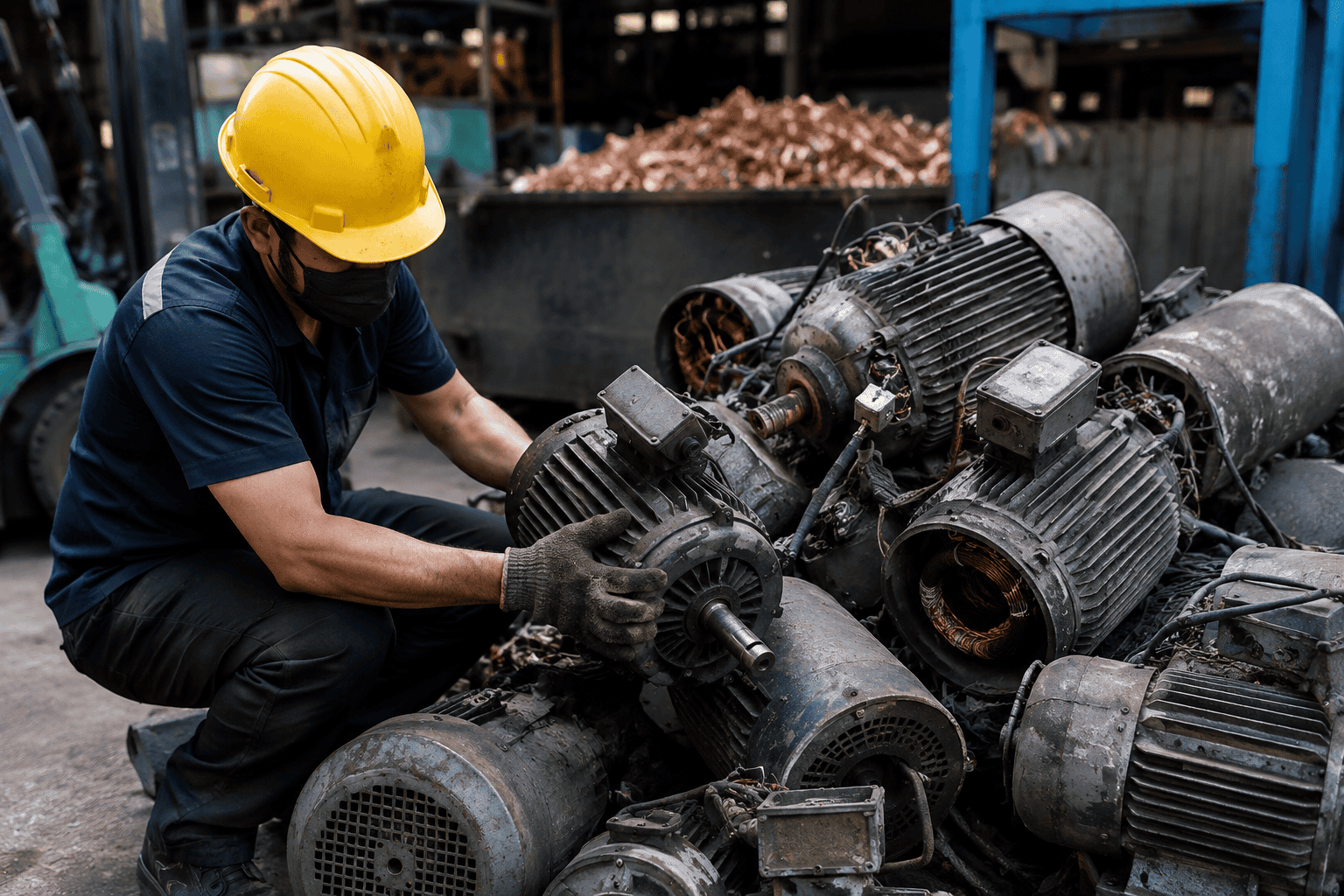
Looking to sell industrial motors in Singapore? Whether you’re clearing out old equipment, upgrading machinery, or managing a factory shutdown, industrial motors can often generate significant scrap value. Even non-working motors contain valuable recoverable metals such as copper, steel, aluminium, and cast iron, making them attractive to scrap buyers.
In this guide, we’ll explain where to sell industrial motors in Singapore, what factors affect their value, and practical tips to help you secure the best possible price for your scrap motors.
Why Industrial Motors Are Worth More Than Most Scrap
Most scrap items are valued purely by weight. Industrial motors are different — their value is driven by the specific metals inside, particularly copper windings, which command a significantly higher price per kilogram than steel.
When a scrap buyer grades a motor, they are essentially estimating its metal composition:
- Copper windings — The biggest value driver. The more copper in the winding, the higher the per-kg rate the motor attracts.
- Steel laminations and shafts — Heavy, but lower in value than copper. Still contributes meaningfully to the overall weight.
- Aluminium or cast iron housing — Common in many motor bodies. Aluminium commands a better rate than cast iron.
- Brass terminals and fittings — A secondary source of value found in certain motor types and connection points.
The key insight: a motor’s scrap value has very little to do with whether it works. A seized or burnt motor can contain just as much copper as a working one — it is simply graded differently.
How Different Motor Types Compare in Scrap Value
Not all motors are equal. The construction of a motor determines what metals are inside and in what proportion.
| Motor Type | Main Metal Content | Relative Copper Content |
|---|---|---|
| 3-Phase Induction Motor | Copper windings + steel laminations | High |
| DC Motor | Copper windings + steel frame | High |
| Single-Phase Motor | Copper windings + steel / aluminium | Medium |
| Gear Motor | Steel gearbox + copper windings | Medium |
| Pump Motor | Cast iron / steel + copper windings | Medium |
| HVAC Fan Motor | Aluminium housing + copper windings | Medium |
| Brake Motor | Steel brake assembly + copper windings | Lower |
| Servo / Explosion-proof Motor | Varies by construction | Case-by-case |
As a general rule: the more copper-dense the motor, the better the scrap rate. 3-phase induction motors and DC motors typically attract the strongest pricing.
Where to Sell Industrial Motors in Singapore?
1. Scrap Metal Recycling Companies
For most businesses, this is the fastest and most convenient option.
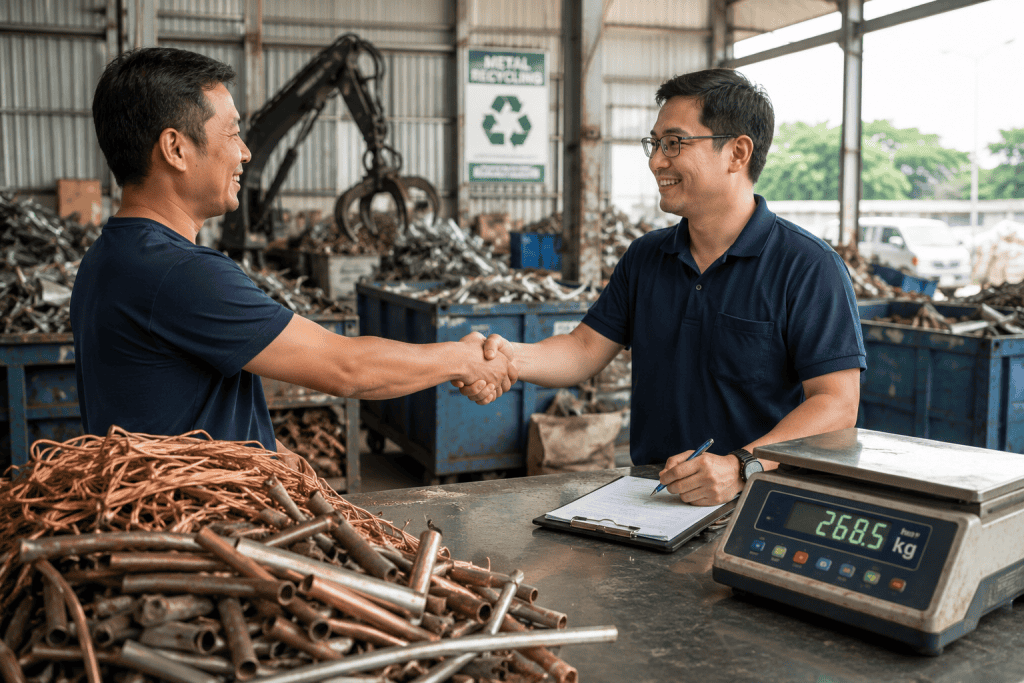
Professional scrap metal recyclers purchase both working and non-working motors, provide accurate grading, and can often arrange collection for larger quantities.
Benefits include:
- Quick quotations
- Bulk collection services
- Transparent weighing
- Prompt payment
- Acceptance of mixed motor conditions
If you’re looking for a reliable industrial motor buyer in Singapore, Choon Sheng Hardware provides competitive pricing, professional scrap metal recycling services, and collection support for factories, warehouses, construction sites, and industrial facilities. Contact us to request a quote or arrange a collection.
2. Used Machinery Dealers
If a motor is relatively new and fully operational, a used machinery dealer may offer a higher resale value than scrap pricing.
However, buyers typically require:
- Testing records
- Working condition verification
- Complete documentation
The process can take longer compared to selling for scrap.
3. Contractor and Industry Networks
Contractors occasionally purchase motors for spare parts or refurbishment projects. While this route may generate higher returns for specific units, negotiations can be lengthy and inconsistent.
Also Read: How to Recycle Metal in Singapore: 6 Steps You Need to Know
What Affects Scrap Motor Prices in Singapore
Scrap prices are not fixed. They move with global commodity markets — primarily copper and steel — and can fluctuate week to week. A few factors that influence what a buyer will offer:
- Copper market conditions. Since copper windings drive most of the value in motors, the LME (London Metal Exchange) copper price has a direct effect on scrap motor rates. When copper is elevated — as it has been for much of 2026, driven by EV and infrastructure demand — motor scrap rates tend to follow.
- Motor grade and condition. Buyers grade motors based on their assessed metal content. A working 3-phase induction motor in good condition attracts a different grade than a burnt or seized one of the same type — though both have scrap value.
- Quantity and logistics. Larger lots are generally more efficient to process. For bulk disposals, the economics of collection and handling can also factor into the offered rate.
- Ease of weighing and access. Motors that are already separated from mixed scrap, accessible by forklift, and clearly documented tend to be quoted more accurately — and sometimes more favourably — than poorly sorted mixed loads.
Note: Always get a quote at time of transaction rather than relying on older indicative pricing, as commodity rates can shift meaningfully between enquiry and collection.
How Scrap Buyers Assess and Grade Industrial Motors
Understanding how buyers evaluate motors helps you present yours in the best light and set realistic expectations.
When you contact a scrap buyer, they will typically ask for:
| Information | Why It Matters |
|---|---|
| Full motor photo | Identifies housing material and general construction |
| Nameplate close-up | Shows kW, voltage, RPM — key for grading |
| Motor type | Determines likely metal composition |
| Condition | Working, untested, seized, or burnt — affects grade |
| Quantity | Single unit or bulk lot |
| Approximate weight or dimensions | Helps with logistics planning |
| Site access details | Loading bay, forklift availability, floor level |
The nameplate is particularly important. It contains the technical specifications that help a buyer estimate copper content without physically stripping the motor. A clear nameplate photo speeds up the quoting process significantly.
How to Get a Better Price When Selling Scrap Motors
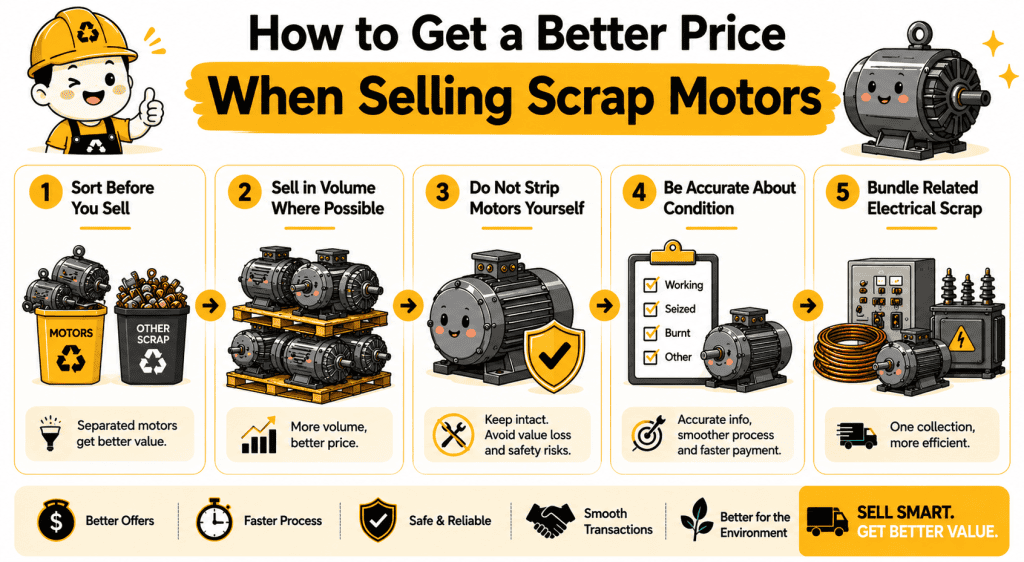
A few practical steps can meaningfully improve what you receive:
- Sort before you sell.
Motors separated from general scrap are easier to grade accurately. Mixed loads attract blended rates that may undervalue high-copper motors in the batch.
- Sell in volume where possible.
Larger lots reduce the per-unit handling cost for buyers, which can translate into a better offer. If you have motors across multiple sites, consolidating before selling often makes sense.
- Do not strip motors yourself unless you know what you are doing.
Incomplete or poorly executed stripping can reduce assessed value, create safety hazards, and complicate the grading process. Most scrap buyers prefer intact motors.
- Be accurate about condition.
Declaring a burnt motor as working — or vice versa — creates problems at the point of collection. Accurate condition reporting from the start leads to cleaner transactions and faster payment.
- Bundle related electrical scrap if clearing a site.
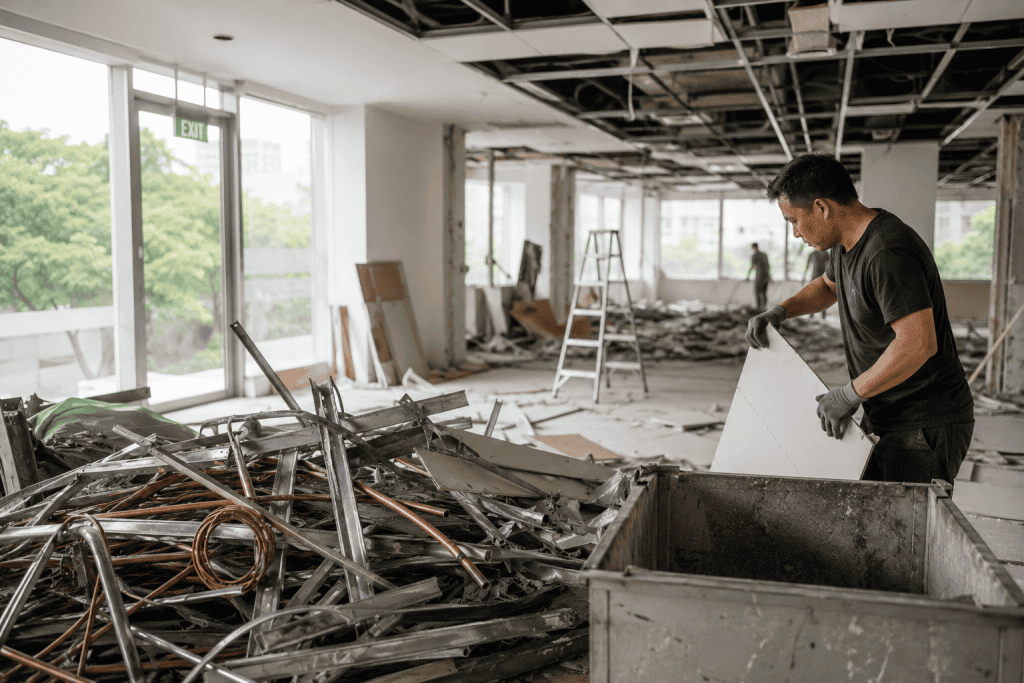
Cable, copper bus bars, switchgear panels, and transformers can often be handled by the same buyer in a single collection, making the logistics of a full factory clearance much simpler.
Environmental Compliance: What You Should Know
Industrial motors fall under the broader category of industrial waste in Singapore, which is regulated by the National Environment Agency (NEA). When engaging a scrap buyer, it is worth confirming that they operate in compliance with applicable NEA guidelines on industrial waste management.
Responsible recycling of motors keeps recoverable copper and steel in the supply chain and diverts material from landfill — an increasingly important consideration for businesses with sustainability reporting requirements.
Also Read: How to Recycle Old Appliances in Singapore: The Complete E-Waste Guide
Making the Most of Your Industrial Motor Disposal at CS Hardware
Selling scrap industrial motors in Singapore is straightforward when you understand what drives value. Copper content is the primary factor, condition matters less than most people assume, and sorting your motors before selling almost always results in a better outcome.
The most important step is working with a buyer who has genuine experience grading electrical equipment — not a general scrap yard that treats motors as undifferentiated metal by weight. Accurate grading means you get a fair reflection of what your motors are actually worth, whether they are working, seized, or burnt.
If you are handling a one-off clearance, a factory relocation, or an ongoing need to dispose of electrical scrap, Choon Sheng Hardware Trading provides transparent grading, competitive pricing, and bulk on-site collection across Singapore. Contact us here!
Frequently Asked Questions
What is the current scrap price for electric motors in Singapore?
Pricing varies depending on copper content, weight, motor type, quantity, and prevailing metal market conditions. Contact a recycler for an up-to-date quotation.
Can burnt or seized motors still be sold?
Yes. Even non-working motors contain recoverable metals and are commonly purchased by scrap recyclers.
Do scrap buyers provide on-site collection for heavy motors?
Many specialist buyers do, particularly for bulk lots. When enquiring, provide details on site access, loading bay availability, floor level, and forklift access so the buyer can arrange appropriate logistics.
Is it worth stripping the copper out myself before selling?
Generally, no — unless you have the equipment and expertise to do it cleanly. Poorly stripped motors can be harder to grade accurately, and buyers may apply a lower rate to account for uncertainty. Most buyers prefer intact motors with a clear nameplate.
How long does the process take from enquiry to payment?
For straightforward drop-off transactions, same-day payment is common. For on-site collection jobs, it depends on scheduling and site logistics — but most bulk collections are completed and settled within a few working days.