61 Kaki Bukit Ave 1, #01-09, Singapore 417943
 +65 6841 0661
7 Challenges of E-Waste Recycling in Singapore and How to Solve Them
Explore the 7 biggest challenges of e-waste recycling in Singapore, from data security to battery risks, and the practical solutions for households and businesses.
Singapore generates around 60,000 tonnes of electronic waste every year, making e-waste one of the country’s fastest-growing waste streams. From old smartphones and laptops to damaged appliances and batteries, electronic waste has become a major environmental concern as technology continues to evolve rapidly.
Although Singapore has introduced national recycling programmes and expanded public collection points through ALBA and the National Environment Agency (NEA), many challenges still prevent e-waste recycling from being fully effective.
Here are some of the biggest e-waste recycling challenges in Singapore — and the solutions that can help improve sustainability efforts.
What Is E-Waste?
E-waste, or electronic waste, refers to discarded electrical or electronic devices that are no longer wanted or functional. Common examples include:
- Mobile phones and tablets
- Laptops and desktop computers
- Chargers, cables, and batteries
- Televisions and monitors
- Refrigerators and washing machines
- Printers and office equipment
Unlike normal household waste, e-waste contains both valuable and hazardous materials. Electronics often include copper, aluminium, and precious metals that can be recovered through recycling. However, they may also contain harmful substances such as lead, mercury, and cadmium, which can pollute the environment if disposed of improperly.
How Singapore Manages E-Waste
E-waste management in Singapore is led by the National Environment Agency (NEA) in partnership with ALBA E-Waste Smart Recycling, operating under the EPR framework. Under this system, producers and importers of regulated electrical and electronic equipment are required to fund the proper collection and recycling of their products at end-of-life.
Current infrastructure includes:
- Public drop-off points: Around 1,000 ALBA e-waste bins islandwide for items like batteries, laptops, and small appliances. By mid-2026, all community centres will have dedicated e-waste bins, bringing total collection points to 1,057.
- Free doorstep collection: ALBA offers free pick-up for large household appliances such as refrigerators and washing machines.
- Retail and partner channels: 23 Shell petrol stations now accept small e-waste items. Many electronics retailers also offer take-back at point of sale.
- ALBA Step Up app: Helps residents locate the nearest collection point and rewards drop-offs with recycling points.
These efforts align with Singapore’s Zero Waste Masterplan, which targets a 30% overall recycling rate as part of the country’s circular economy goals.
Also Read: Singapore Scrap Metal Price Guide: Current Rates & Values (2026)
7 Challenges of E-Waste Recycling in Singapore
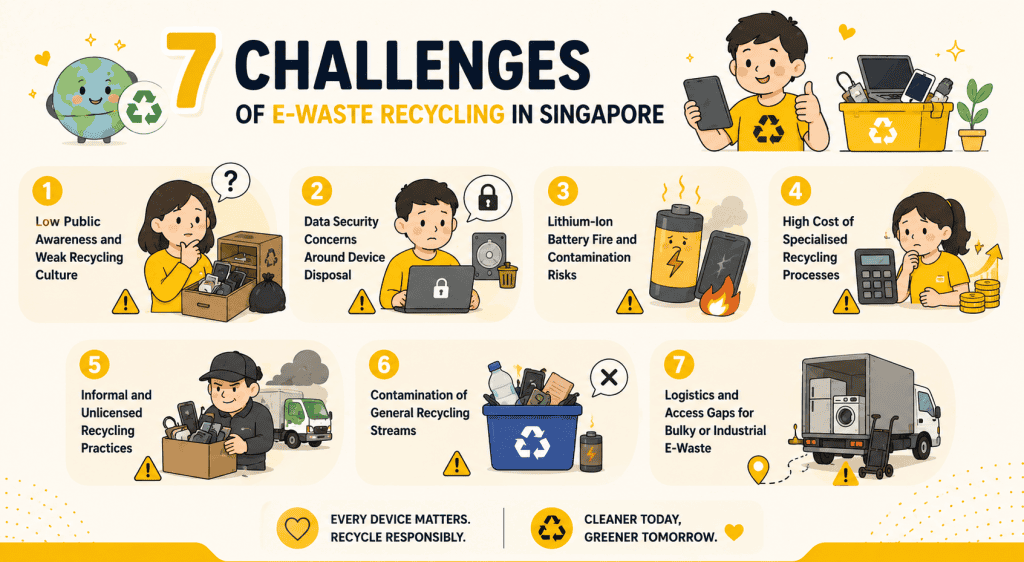
1. Low Public Awareness and Weak Recycling Culture
Most residents know they should not throw electronics in the blue bin — but far fewer know what to do instead. Old phones, cables, and chargers pile up in drawers for years, or quietly end up in general waste at the moment of disposal.
The barrier is rarely distance to a collection point. Research consistently shows the bigger issue is that e-waste disposal does not cross people’s minds when a device stops working or gets replaced. Without that moment of conscious intention, even the most convenient infrastructure goes unused.
2. Data Security Concerns Around Device Disposal
Fear of data exposure is one of the most underreported reasons people hold on to old devices — or throw them in general waste rather than recycling properly.
The concern is legitimate. A factory reset does not securely erase data. Studies have repeatedly shown that data can be recovered from reset smartphones and wiped hard drives using commercially available tools. For businesses, devices may contain customer records, financial data, or information subject to the Personal Data Protection Act (PDPA) — making improper disposal a compliance risk, not just a privacy concern.
3. Lithium-Ion Battery Fire and Contamination Risks
Lithium-ion batteries are in virtually every modern device — smartphones, laptops, tablets, and power banks. They are also one of the primary reasons e-waste cannot be handled like other recyclables.
A damaged, swollen, or improperly crushed lithium-ion battery can ignite. Fires caused by batteries in compactors and waste collection vehicles have been reported across Singapore and the wider region. Proper management requires pre-sorting, careful discharge protocols, and downstream processors with specialist equipment — adding cost and complexity at every stage of the recycling chain.
4. High Cost of Specialised Recycling Processes
The same material complexity that makes e-waste valuable also makes it expensive to recycle responsibly. Separating copper, aluminium, precious metal traces, plastics, and hazardous substances requires labour-intensive processes and specialist equipment.
For lower-value items — old chargers, cables, small appliances — the cost of responsible recycling can exceed the value of materials recovered. This economic imbalance creates pressure in the recycling chain and is one reason informal, non-compliant recycling persists. The EPR scheme covers a defined list of regulated products, but many industrial and commercial devices fall outside it, leaving disposal costs with the business.
5. Informal and Unlicensed Recycling Practices
Some electronic waste in Singapore is still handled by informal collectors or unlicensed operators. While these services may appear convenient, they do not always follow proper environmental or safety standards.
Improper handling may result in:
- unsafe dismantling,
- illegal dumping,
- environmental pollution,
- or poor data security practices.
6. Contamination of General Recycling Streams
When e-waste ends up in the blue bin or general waste, the consequences extend beyond that single item. A battery in a compactor can cause a fire. Heavy metals from circuit boards — lead, cadmium, mercury — can leach into waste streams if processed through channels not designed for them.
Contamination is not always deliberate. Many residents genuinely do not know whether a smart plug, an electric toothbrush, or a blender counts as e-waste. The distinction between regulated and non-regulated e-waste is not widely understood.
| Item | Blue Bin? | Where to Dispose |
|---|---|---|
| Paper, cardboard | ✓ Yes | Blue recycling bin |
| Plastic bottles | ✓ Yes | Blue recycling bin |
| Mobile phones, tablets | ✗ No | E-waste bin or licensed collector |
| Laptops, chargers, cables | ✗ No | E-waste bin or licensed collector |
| Refrigerators, washing machines | ✗ No | ALBA free doorstep collection |
| Fans, rice cookers, blenders | ✗ No | Non-regulated e-waste bin |
7. Logistics and Access Gaps for Bulky or Industrial E-Waste
Public e-waste infrastructure is designed for consumer items. It is not designed for a business disposing of 50 decommissioned monitors, a data centre clearing servers, or a facility with industrial machinery and air-conditioning compressors at end-of-life.
Without a clear, cost-effective disposal route, businesses often delay — accumulating devices in storage — or default to general waste disposal, which is non-compliant. The challenge is compounded in industrial estates where large-vehicle access may be limited, or where items need on-site dismantling before transport.
Also Read: 7 Tips for Selling Scrap Metal in Singapore (2026)
Solutions: What Households and Businesses Can Do
1. Build the Habit, Not Just the Infrastructure
For households, the most practical step is to designate a collection spot at home — a bag or box specifically for cables, old phones, and small electronics. When it is full, it goes to the nearest ALBA bin or drop-off point.
2. Use Certified Data Destruction for Peace of Mind
The solution to data security concerns is not to hold on to devices indefinitely — it is to use a licensed recycler that offers certified data destruction. Physical destruction or degaussing of storage media by a licensed facility, backed by a certificate of destruction, converts a liability into a resolved compliance matter and satisfies PDPA obligations.
3. Route Battery-Containing Devices to Licensed Handlers
The fire risk from lithium-ion batteries is real but manageable when devices are handled by trained staff using the right processes. The key is ensuring battery-containing items — phones, laptops, power banks — reach licensed collectors rather than general waste or informal channels.
4. Leverage Scrap Value to Offset Recycling Costs
Not all e-waste costs money to dispose of responsibly. Devices and equipment with significant metal content — servers, desktop computers, industrial machinery — contain recoverable copper, aluminium, and in some cases precious metals. A licensed recycler can assess scrap value and offset this against disposal fees, reducing or in some cases eliminating the net cost.
5. Use Licensed Collectors for Documented, Compliant Disposal
For businesses, the alternative to informal collectors is a licensed recycler who provides documentation for every collection. This removes the audit trail gap, ensures materials are processed to NEA standards, and protects against downstream liability. The paperwork is not a burden — it is the record that confirms devices were handled correctly.
Recycle Responsibly with a Licensed Partner You Can Trust
At Choon Sheng Hardware, sustainability is at the heart of our operations. As a licensed metal waste dismantler under NEA regulations, we are dedicated to environmentally responsible recycling and recovery practices — helping households and businesses across Singapore dispose of e-waste correctly, safely, and with full accountability.
Our core capabilities include:
- Metal and wire recycling — specialising in copper, aluminium, and other valuable metals recovered from electronic equipment
- Battery collection and recycling — ensuring safe handling and proper disposal of lithium-ion and other battery types
- Professional dismantling — using certified equipment and skilled technicians to process e-waste at our Kaki Bukit facility
- Sustainable operations — reducing waste sent to landfill and protecting natural resources through responsible material recovery
Together, we aim to contribute to Singapore’s circular economy — turning end-of-life electronics into resources, not waste.
Ready to Dispose of Your E-Waste the Right Way?
E-waste recycling in Singapore has come a long way — but the gap between what is generated and what is properly recycled remains significant. From data security fears to battery risks and logistics barriers, the seven challenges above show that proper e-waste disposal requires more than good intentions. It requires the right partner.
As a licensed NEA dealer since 2013 with 1,000+ clients across Singapore, Choon Sheng Hardware handles e-waste and scrap metal recycling for both households and businesses — with competitive pricing, transparent processes, and full regulatory compliance at every step.
Whether you need a scheduled bulk collection or simply want to know more about safe disposal, our team is ready to help. Contact us today.
Frequently Asked Questions
What is the biggest challenge in recycling e-waste in Singapore?
The most persistent challenge is low public awareness combined with weak habits at the point of disposal. Even with a growing network of collection points, most people do not think about recycling when they replace a device. Data security concerns and confusion about what qualifies as e-waste compound the problem.
Why can’t I throw e-waste in the blue recycling bin?
E-waste contains hazardous components — lithium-ion batteries, heavy metals, and toxic substances in circuit boards — that can cause fires or contaminate other recyclables when processed through general recycling equipment. E-waste must go to dedicated e-waste bins or licensed collectors with the right handling infrastructure.
Is it safe to recycle hard drives in Singapore?
Yes, if you use a licensed recycler that offers certified data destruction. A factory reset is not sufficient — data can often be recovered from reset devices. Licensed facilities can physically destroy or degauss storage media and issue a certificate of destruction for compliance records.
Can you get cash for e-waste in Singapore?
In some cases, yes. Devices and equipment with recoverable metals — copper, aluminium, gold traces — may have scrap value that offsets disposal costs. At Choon Sheng, we assess the scrap value of items at collection and apply this against applicable service fees.