61 Kaki Bukit Ave 1, #01-09, Singapore 417943
 +65 6841 0661
5 Steps Metal Recycling Process: The Complete Facility Workflow
Discover the complete metal recycling process. Learn the exact steps from scrap metal sorting and shredding to magnetic separation and electrolytic refining.
Metal recycling is far more than simply collecting old metal and melting it down. Modern recycling facilities rely on advanced technology, automated equipment, and strict quality control procedures to transform discarded scrap into valuable raw materials that can be used in manufacturing again.
Every stage of the recycling process plays a vital role in ensuring high recovery rates, reducing waste, and producing metals that meet industry standards. From initial sorting to final purification, each step improves material quality while supporting sustainable resource management.
Whether the scrap comes from construction sites, manufacturing plants, demolition projects, or household waste, understanding the metal recycling process helps businesses appreciate how valuable materials are recovered instead of ending up in landfills.
Understanding the Metal Recycling Facility Workflow
A professional recycling facility follows a structured workflow designed to maximize efficiency and minimize material loss. Each stage prepares the scrap for the next process while removing contaminants that could reduce the quality of the final product.
The typical metal recycling process includes:
- Scrap metal collection
- Material sorting
- Shredding and baling
- Advanced metal separation
- Melting
- Refining and purification
- Production of reusable raw materials
Modern recycling plants also use automated monitoring systems and quality inspections throughout the workflow to ensure every batch meets industry specifications.
Also Read: Why Selling Scrap Metal Matters in Singapore? Benefits & Recycling Guide
How the Metal Recycling Process Works
Facilities process scrap metal through defined stages that prepare materials, separate metal types, and purify the final output. The workflow below follows industry standards such as those set by ISRI, and is largely consistent across processing facilities worldwide.
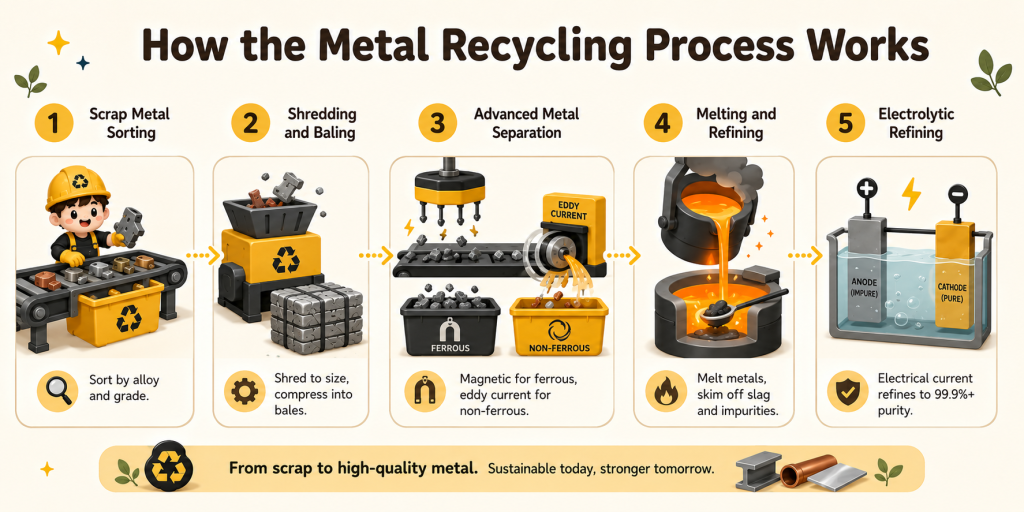
Step 1: Scrap Metal Sorting
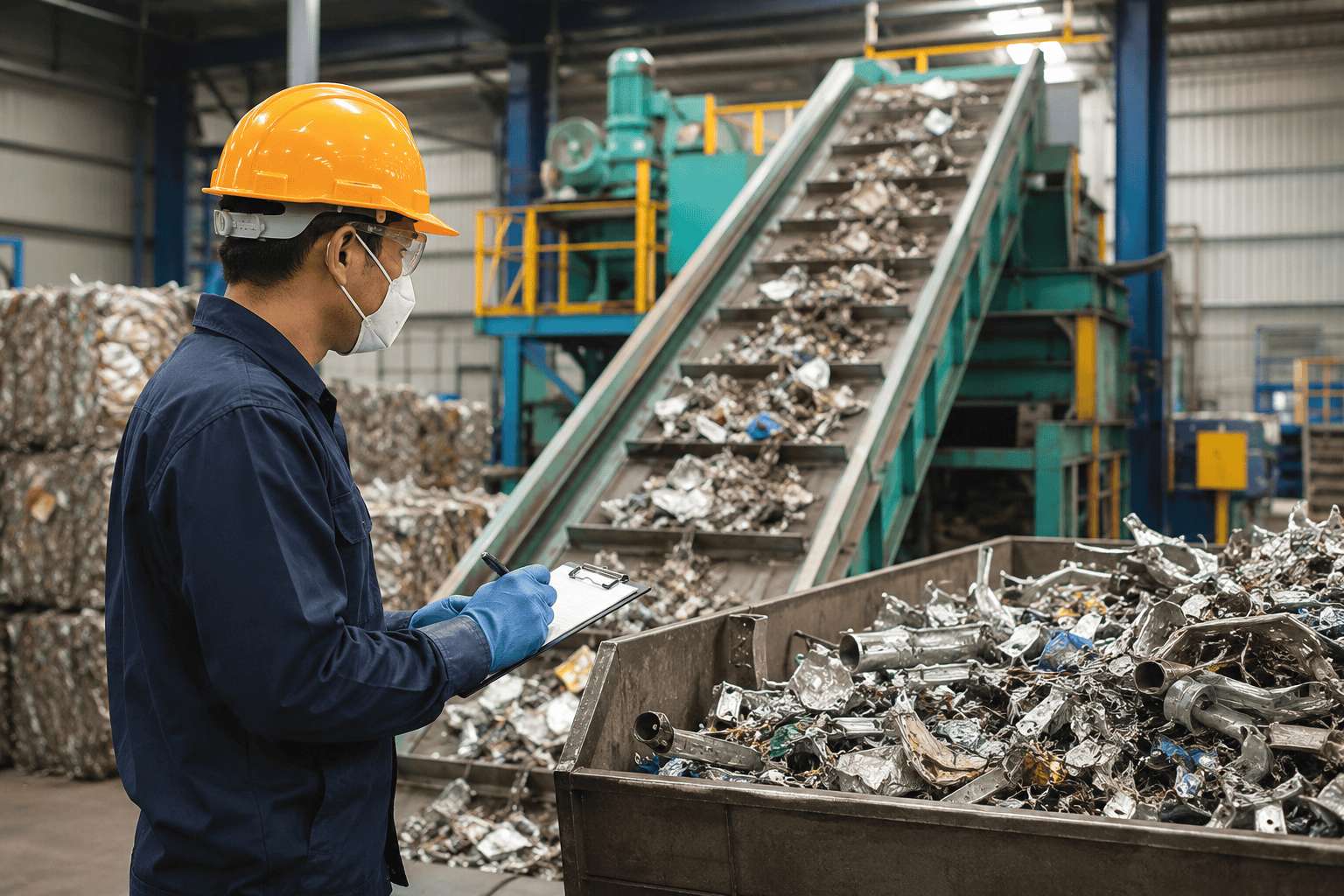
Operators sort incoming scrap by alloy and grade, combining manual inspection with automated sensors for accuracy. This initial step prevents contamination in later stages. Scrap arrives in various forms from industrial sources and consumers, and classification follows established categories for steel, aluminum, copper, and others.
Step 2: Shredding and Baling
Shredders reduce large pieces to a uniform size, while baling machines compress sorted metals into dense blocks. These actions increase density and improve handling efficiency before separation. High-torque shredders handle everything from household appliances to vehicle bodies, and baling can reduce volume by up to 90 percent.
Step 3: Advanced Metal Separation
Separation technologies isolate ferrous from non-ferrous metals using two main methods:
- Magnetic separation uses overhead magnets or drum separators to pull iron and steel from the material flow, relying on magnetic attraction.
- Eddy current separation generates changing magnetic fields that induce currents in aluminum, copper, and similar non-ferrous metals. The resulting repulsion ejects these metals from the conveyor, a physics-based approach that achieves clean separation without manual intervention. The separator features a high-speed rotor with rare earth magnets, with rotation speeds reaching thousands of RPM to generate the necessary field frequency.
| Separation Method | Target Metals | Mechanism |
|---|---|---|
| Magnetic | Ferrous | Uses magnetic fields to attract iron-containing metals |
| Eddy Current | Non-ferrous | Creates opposing fields via induced currents to repel metals |
Step 4: Melting and Refining
Furnaces melt the separated metals, with temperature control used to prevent oxidation where possible. During melting, impurities rise as slag and workers skim it off to remove it from the molten metal. This reduces contaminants and prepares the metal for further purification. Slag consists of oxides, silicates, and other non-metallic compounds, some facilities even recycle slag for use as construction aggregate.
Step 5: Electrolytic Refining for High-Purity Metals
For applications requiring exceptional purity, facilities use electrolytic refining. Electrical current is applied in solution: impure metal dissolves from the anode, and pure metal plates onto the cathode. This process yields metals with purity exceeding 99.9 percent, suitable for use in electronics and manufacturing. The electrolyte solution typically contains metal salts, and current density and voltage are carefully controlled to optimize deposition rate and purity.
What Happens to Recycled Metal After Refining
Once metal has been refined to the required purity, it doesn’t stay at the facility, it re-enters the supply chain as raw material for new products. Refined copper is drawn into new wiring and electrical components. Steel is re-rolled into sheets, beams, and rebar for construction. Aluminium is recast into everything from packaging to vehicle parts.
This is what makes metal recycling fundamentally different from most other waste streams: metal can be melted down and reused indefinitely without significant loss of quality. A copper wire recycled today can realistically become part of a new appliance within weeks, closing the loop between industrial waste and industrial supply.
Also Read: How to Recycle Old Appliances in Singapore: The Complete E-Waste Guide
Benefits of Recycling Scrap Metal in Singapore
- Reduces import dependency — Singapore has no natural mineral deposits, so recycled metal directly offsets the need to import raw ore
- Uses less energy than producing new metal from scratch, lowering the overall environmental footprint
- Extends landfill lifespan by keeping heavy, non-biodegradable materials out of disposal sites
- Recovers real cash value — businesses closing a factory, vacating a warehouse, or upgrading equipment can get paid instead of paying disposal fees
- Supports national sustainability goals under the National Environment Agency’s waste management framework
- Improves site safety by clearing scrap metal clutter from workshops, warehouses, and construction sites
The Complete Recycling Facility Workflow
Modern recycling facilities integrate every stage of the process into a highly automated production line.
Conveyors, sensors, robotics, and computerized monitoring systems continuously move materials from one phase to the next while minimizing losses.
A complete recycling workflow typically follows this sequence:
- Collection and delivery
- Scrap sorting
- Shredding
- Baling
- Magnetic separation
- Eddy current separation
- Melting
- Slag removal
- Electrolytic refining
- Casting into reusable raw materials
This integrated approach enables facilities to recover valuable resources efficiently while reducing landfill waste, conserving natural resources, and lowering carbon emissions compared to primary metal production.
If your business generates industrial scrap metal, partnering with an experienced recycling company can improve waste management, recover material value, and support your sustainability goals.
Turn Your Scrap Into Value at Choon Sheng Hardware
From the moment scrap arrives at a facility to the moment it’s refined into high-purity material, metal recycling is a precise, multi-stage process, not a simple dump-and-melt operation. Each step, from sorting to electrolytic refining, plays a role in maximising recovery and minimising waste.
At Choon Sheng Hardware Trading, we handle this entire process for businesses and individuals across Singaporem from sorting and grading your scrap to ensuring it reaches certified recycling partners for proper processing. Whether you have a small load or a full factory clearance, our team at Kaki Bukit offers fair weighing, transparent pricing, and reliable collection. Get in touch for a free quote today.
Frequently Asked Questions
What are the essential metal recycling steps?
The essential steps include sorting, shredding and baling, advanced separation using magnetic and eddy current methods, melting, and electrolytic refining.
How does eddy current separation separate non-ferrous metals?
Eddy current separation uses rotating magnets to induce electrical currents in non-ferrous metals, creating opposing magnetic fields that repel and eject the metals from the material stream.
What happens to slag and impurities during the melting process?
Impurities form slag that rises to the surface of the molten metal and is skimmed off to reduce contaminants before further refining.
Why is shredding and baling necessary before melting?
Shredding creates uniform particle sizes and baling increases density, which improves handling, transport efficiency, and melting consistency.